Freitag, 7. September 2018

SEO "Dinosaur" Tactics That You Should Retire - Whiteboard Friday

Posted by randfish

It's tough to admit it, but many of us still practice outdated SEO tactics in the belief that they still have a great deal of positive influence. In this week's Whiteboard Friday, Rand gently sets us straight and offers up a series of replacement activities that will go much farther toward moving the needle. Share your own tips and favorites in the comments!

Click on the whiteboard image above to open a high-resolution version in a new tab!

Video Transcription

Howdy, Moz fans, and welcome to another edition of Whiteboard Friday. This week we're going to go back in time to the prehistoric era and talk about a bunch of "dinosaur" tactics, things that SEOs still do, many of us still do, and we probably shouldn't.

We need to replace and retire a lot of these tactics. So I've got five tactics, but there's a lot more, and in fact I'd loved to hear from some of you on some of yours.

Dino Tactic #1: AdWords/Keyword Planner-based keyword research

But the first one we'll start with is something we've talked about a few times here — AdWords and Keyword Planner-based keyword research. So you know there's a bunch of problems with the metrics in there, but I still see a lot of folks starting their keyword research there and then expanding into other tools.

Replace it with clickstream data-driven tools with Difficulty and CTR %

My suggestion would be start with a broader set if you possibly can. If you have the budget, replace this with something that is driven by clickstream data, like Ahrefs or SEMrush or Keyword Explorer. Even Google Search Suggest and related searches plus Google Trends tend to be better at capturing more of this.

Why it doesn't work

I think is just because AdWords hides so many keywords that they don't think are commercially relevant. It's too inaccurate, especially the volume data. If you're actually creating an AdWords campaign, the volume data gets slightly better in terms of its granularity, but we found it is still highly inaccurate as compared as to when you actually run that campaign.

It's too imprecise, and it lacks a bunch of critical metrics, including difficulty and click-through rate percentage, which you've got to know in order to prioritize keywords effectively.

Dino Tactic #2: Subdomains and separate domains for SERP domination

Next up, subdomains and separate domains for SERP domination. So classically, if you wanted to own the first page of Google search results for a branded query or an unbranded query, maybe you just want to try and totally dominate, it used to be the case that one of the ways to do this was to add in a bunch of subdomains to your website or register some separate domains so that you'd be able to control that top 10.

Why it doesn't work

What has happened recently, though, is that Google has started giving priority to multiple subpages in a single SERP from a single domain. You can see this for example with Yelp on virtually any restaurant-related searches, or with LinkedIn on a lot of business topic and job-related searches.

You can see it with Quora on a bunch of question style searches, where they'll come up for all of them, or Stack Overflow, where they come up for a lot of engineering and development-related questions.

Replace it with barnacle SEO and subfolder hosted content

So one of the better ways to do this nowadays is with barnacle SEO and subfolder hosted content, meaning you don't have to put your content on a separate subdomain in order to rank multiple times in the same SERP.

Barnacle SEO also super handy because Google is giving a lot of benefit to some of these websites that host content you can create or generate and profiles you can create and generate. That's a really good way to go. This is mostly just because of this shift from the subdomains being the way to get into SERPs multiple times to individual pages being that path.

Dino Tactic #3: Prioritizing number one rankings over other traffic-driving SEO techniques

Third, prioritizing number one rankings over other traffic-driving SEO techniques. This is probably one of the most common "dinosaur" tactics I see, where a lot of folks who are familiar with the SEO world from maybe having used consultants or agencies or brought it in-house 10, 15, 20 years ago are still obsessed with that number one organic ranking over everything else.

Replace it with SERP feature SEO (especially featured snippets) and long-tail targeting

In fact, that's often a pretty poor ROI investment compared to things like SERP features, especially the featured snippet, which is getting more and more popular. It's used in voice search. It oftentimes doesn't need to come from the number one ranking result in the SERP. It can come number three, number four, or number seven.

It can even be the result that brings back the featured snippet at the very top. Its click-through rate is often higher than number one, meaning SERP features a big way to go. This is not the only one, too. Image SEO, doing local SEO when the local pack appears, doing news SEO, potentially having a Twitter profile that can rank in those results when Google shows tweets.

And, of course, long-tail targeting, meaning going after other keywords that are not as competitive, where you don't need to compete against as many folks in order to get that number one ranking spot, and often, in aggregate, long tail can be more than ranking number one for that "money" keyword, that primary keyword that you're going after.

Why it doesn't work

Why is this happening? Well, it's because SERP features are biasing the click-through rate such that number one just isn't worth what it used to be, and the long tail is often just higher ROI per hour spent.

Dino Tactic #4: Moving up rankings with link building alone

Fourth, moving up the rankings on link building alone. Again, I see a lot of people do this, where they're ranking number 5, number 10, number 20, and they think, "Okay, I'm ranking in the first couple of pages of Google. My next step is link build my way to the top."

Why it no longer works on its own

Granted, historically, back in the dinosaur era, dinosaur era of being 2011, this totally worked. This was "the" path to get higher rankings. Once you were sort of in the consideration set, links would get you most of the way up to the top. But today, not the case.

Replace it with searcher task accomplishment, UX optimization, content upgrades, and brand growth

Instead I'm going to suggest you retire that and replace it with searcher task accomplishment, which we've seen a bunch of people invest in optimization there and springboard their site, even with worse links, not as high DA, all of that kind of stuff. UX optimization, getting the user experience down and nailing the format of the content so that it better serves searchers.

Content upgrades, improving the actual content on the page, and brand growth, associating your brand more with the topic or the keyword. Why is this happening? Well, because links alone it feels like today are just not enough. They're still a powerful ranking factor. We can't ignore them entirely certainly.

But if you want to unseat higher ranked pages, these types of investments are often much easier to make and more fruitful.

Dino Tactic #5: Obsessing about keyword placement in certain tags/areas

All right, number five. Last but not least, obsessing about keyword placement in certain tags and certain areas. For example, spending inordinate amounts of time and energy making sure that the H1 and H2, the headline tags, can contain keywords, making sure that the URL contains the keywords in exactly the format that you want with the hyphens, repeating text a certain number of times in the content, making sure that headlines and titles are structured in certain ways.

Why it (kind of) doesn't work

It's not that this doesn't work. Certainly there's a bare minimum. We've got to have our keyword used in the title. We definitely want it in the headline. If that's not in an H1 tag, I think we can live with that. I think that's absolutely fine. Instead I would urge you to move some of that same obsession that you had with perfecting those tags, getting the last 0.01% of value out of those into related keywords and related topics, making sure that the body content uses and explains the subjects, the topics, the words and phrases that Google knows searchers associate with a given topic.

My favorite example of this is if you're trying to rank for "New York neighborhoods" and you have a page that doesn't include the word Brooklyn or Manhattan or Bronx or Queens or Staten Island, your chances of ranking are much, much worse, and you can get all the links and the perfect keyword targeting in your H1, all of that stuff, but if you are not using those neighborhood terms that Google clearly can associate with the topic, with the searcher's query, you're probably not going to rank.

Replace it with obsessing over related keywords and topics

This is true no matter what you're trying to rank for. I don't care if it's blue shoes or men's watches or B2B SaaS products. Google cares a lot more about whether the content solves the searcher's query. Related topics, related keywords are often correlated with big rankings improvements when we see folks undertake them.

I was talking to an SEO a few weeks ago who did this. They just audited across their site, found the 5 to 10 terms that they felt they were missing from the content, added those into the content intelligently, adding them to the content in such a way that they were actually descriptive and useful, and then they saw rankings shoot up with nothing else, no other work. Really, really impressive stuff.

So take some of these dino tactics, try retiring them and replacing them with some of these modern ones, and see if your results don't come out better too. Look forward to your thoughts on other dino tactics in the comments. We'll see you again next week for another edition of Whiteboard Friday. Take care.

Video transcription by Speechpad.com


Sign up for The Moz Top 10, a semimonthly mailer updating you on the top ten hottest pieces of SEO news, tips, and rad links uncovered by the Moz team. Think of it as your exclusive digest of stuff you don't have time to hunt down but want to read!


from Moz Blog https://ift.tt/2M7o3cy
http://e-bms.de

Mittwoch, 5. September 2018

How We More than Doubled Conversions & Leads for a New ICO [Case Study]

Posted by jkuria

Summary

We helped Repux generate 253% more leads, nearly 100% more token sales and millions of dollars in incremental revenue during their initial coin offering (ICO) by using our CRO expertise.

The optimized site also helped them get meetings with some of the biggest names in the venture capital community — a big feat for a Poland-based team without the pedigree typically required (no MIT, Stanford, Ivy League, Google, Facebook, Amazon, Microsoft background).

The details:

Repux is a marketplace that lets small and medium businesses sell anonymized data to developers. The developers use the data to build “artificially intelligent” apps, which they then sell back to businesses. Business owners and managers use the apps to make better business decisions.

Below is the original page, which linked to a dense whitepaper. We don’t know who decided that an ICO requires a long, dry whitepaper, but this seems to be the norm!

A screenshot of a cell phone Description generated with very high confidence

This page above suffers from several issues:

  • The headline is pretty meaningless (“Decentralized Data & Applications Protocol for SMEs). Remember, as David Ogilvy noted, 90% of the success of an ad (in our case, a landing page) is determined by the headline. Visitors quickly scan the headline and if it doesn’t hold their interest, bounce immediately. With so much content on the web, attention is scarce — the average time spent on a page is a few seconds and the average bounce rate is about 85%.
  • The call to action is “Get Whitelisted,” which is also meaningless. What's in it for me? Why should I want to “Get Whitelisted”?
  • A lack of urgency to act. There is a compelling reason to do so, but it was not being clearly articulated ("Get 50% OFF on the tokens if you buy before a certain date.")
  • Lack of “evidentials”: Evidentials are elements that lend credibility or reduce anxiety and include things like mentions in trusted publications, well-known investors or advisors, industry seals, association affiliations, specific numbers (e.g. 99% Net Promoter Score), and so on.
  • Too much jargon and arcane technical language: Our research using Mouseflow’s on-page feedback feature showed that the non-accredited-investor ICO audience isn’t sophisticated. They typically reside outside of the US and have a limited command of English. Most are younger men (18–35) who made money from speculative activities on the Internet (affiliate marketing, Adsense arbitrage, and of course other crypto-currencies). When we surveyed them, many did not initially understand the concept. In our winning page (below), we dumbed down things a lot!

Below is the new page that produced a 253% gain in leads (email opt-ins). Coupled with the email follow-up sequence shown below, it produced a nearly 100% gain in token sales.

Winning page (above the fold):

Here are few of the elements that we believe made a difference:

  • Much clearer headline (which we improved upon further in a subsequent treatment).
  • Simple explanation of what the company is doing
  • Urgency to buy now — get 50% off on tokens if you buy before the countdown timer expires
  • Solicited and used press mentions
  • Social proof from the Economist; tapping a meme can be powerful as it's always easier to swim downstream than upstream. “Data is the new oil” is a current meme.

More persuasive elements (below the fold):

In the second span (the next screenful below the fold) we added a few more persuasive elements.

For one, we highlighted key Repux accomplishments and included bios of two advisors who are well known in the crypto-community.

Having a working platform was an important differentiator because only one in 10 ICOs had a working product. Most launched with just a whitepaper!

A survey of the token buyers showed that mentioning well-known advisors worked — several respondents said it was the decisive factor in persuading them to buy. Before, the advisors were buried in a little-visited page. We featured them more prominently.

Interestingly, this seemed to cut both ways. One of the non-contributors said he was initially interested because of a certain advisor’s involvement. He later chose not to contribute because he felt this advisor’s other flagship project had been mismanaged!

We also used 3 concrete examples to show how the marketplace functions and how the tokens would be used:

When your product is highly abstract and technical, using concrete examples aids understanding. We also found this to be true when pitching to professional investors. They often asked, “Can you give me an example of how this would work in the real world?”

We like long-form pages because unlike a live selling situation, there's no opportunity for a back-and-forth conversation. The page must therefore overcorrect and address every objection a web visitor might have.

Lastly, we explained why Repux is likely to succeed. We quoted Victor Hugo for good measure, to create an air of inevitability:

How much impact did Victor Hugo have? I don’t know, but the page did much better overall. Our experience shows that radical redesigns (that change many page elements at the same time) produce higher conversion lifts.

Once you attain a large lift, if you like, you can then do isolation testing of specific variables to determine how much each change contributed.

13% lift: Simplified alternate page

The page below led to a further 13% lift.

The key elements we changed were:

  • Simplified the headline even further: “Repux Monetizes Data from Millions of Small Enterprises.” What was previously the headline is now stated in the bullet points.
  • Added a “5 Reasons Why Repux is Likely to Succeed” section: When you number things, visitors are more likely to engage with the content. They may not read all the text but will at least skim over the numbered sub-headlines to learn what all the points are — just like power abhors a vacuum, the mind can’t seem to stand incompleteness!

We’ve seen this in Mouseflow heatmaps. You can do this test yourself: List a bunch of bullet points versus a numbered list and with a compelling headline: The 7 Reasons Why 20,0000 Doctors Recommend Product X or The 3 Key Things You Need to Know to Make an Informed Decision.

C:\Users\jkuri\AppData\Local\Temp\SNAGHTML26c90c7c.PNG

Follow-up email sequence

We also created a follow-up email sequence for Repux that led to more token sales.

C:\Users\jkuri\AppData\Local\Temp\SNAGHTML4824f99e.PNG

As you can see, the average open rate is north of 40%, and the goal attained (token sales) is above 8%. According to Mailchimp, the average email marketing campaign open rate is about 20%, while the average CTR is about 3%.

We got more sales than most people get clicks. Here’s a link to three sample emails we sent.

Our emails are effective because:

  • They’re educational (versus pure sales pitch). This is also important to avoid “burning out” your list. If all you do is send pitch after pitch, soon you’ll be lucky to get a 1.3% open rate!
  • They employ storytelling. We use a technique known as the “Soap Opera Sequence.” Each email creates anticipation for the next one and also refers to some interesting fact in previous ones. If a person would only have opened one email, they are now likely to want to open future ones as well as look up older ones to “solve the puzzle.” This leads to higher open rates for the entire sequence, and more sales.
  • The calls to action are closer to the bottom, having first built up some value. Counterintuitively, this works better, but you should always test radically different approaches.

Email is a massively underutilized medium. Most businesses are sitting on goldmines (their email list) without realizing it! You can — and should — make at least 2x to 3x as many sales from your email list as you do from direct website sales.

It takes a lot of work to write an effective sequence, but once you do you can run it on autopilot for years, making money hand over fist. As customer acquisition gets ever more competitive and expensive, how well you monetize your list can make the difference between success and failure.

Conclusion

To increase the conversion rate on your website and get more sales, leads, or app downloads, follow these simple steps:

  • Put in the work to understand why the non-converting visitors are leaving and then systematically address their specific objections. This is what “research-driven” optimization means, as opposed to redesign based purely aesthetic appeal or “best practices.”
  • Find out why the converting visitors took the desired action — and then accentuate these things.
  • Capture emails and use a follow-up sequence to educate and tell stories to those who were not convinced by the website. Done correctly, this can produce 2x to 3x as many sales as the website.

Simple, but not easy. It takes diligence and discipline to do these things well. But if you do, you will be richly rewarded!

And if you’d like to learn more about conversion rate optimization or review additional case studies, we encourage you to take our free course.

Thanks to Jon Powell, Hayk Saakian, Vlad Mkrtumyan, and Nick Jordan for reading drafts of this post.


Sign up for The Moz Top 10, a semimonthly mailer updating you on the top ten hottest pieces of SEO news, tips, and rad links uncovered by the Moz team. Think of it as your exclusive digest of stuff you don't have time to hunt down but want to read!


from Moz Blog https://ift.tt/2NeQ8mM
http://e-bms.de

Montag, 3. September 2018

Internal Linking & Mobile First: Large Site Crawl Paths in 2018 & Beyond

Posted by Tom.Capper

By now, you’ve probably heard as much as you can bear about mobile first indexing. For me, there’s been one topic that’s been conspicuously missing from all this discussion, though, and that’s the impact on internal linking and previous internal linking best practices.

In the past, there have been a few popular methods for providing crawl paths for search engines — bulky main navigations, HTML sitemap-style pages that exist purely for internal linking, or blocks of links at the bottom of indexed pages. Larger sites have typically used at least two or often three of these methods. I’ll explain in this post why all of these are now looking pretty shaky, and what I suggest you do about it.

Quick refresher: WTF are “internal linking” & “mobile-first,” Tom?

Internal linking is and always has been a vital component of SEO — it’s easy to forget in all the noise about external link building that some of our most powerful tools to affect the link graph are right under our noses. If you’re looking to brush up on internal linking in general, it’s a topic that gets pretty complex pretty quickly, but there are a couple of resources I can recommend to get started:

I’ve also written in the past that links may be mattering less and less as a ranking factor for the most competitive terms, and though that may be true, they’re still the primary way you qualify for that competition.

A great example I’ve seen recently of what happens if you don’t have comprehensive internal linking is eflorist.co.uk. (Disclaimer: eFlorist is not a client or prospective client of Distilled, nor are any other sites mentioned in this post)

eFlorist has local landing pages for all sorts of locations, targeting queries like “Flower delivery in [town].” However, even though these pages are indexed, they’re not linked to internally. As a result, if you search for something like “flower delivery in London,” despite eFlorist having a page targeted at this specific query (which can be found pretty much only through use of advanced search operators), they end up ranking on page 2 with their “flowers under £30” category page:

¯\_(ツ)_/¯

If you’re looking for a reminder of what mobile-first indexing is and why it matters, these are a couple of good posts to bring you up to speed:

In short, though, Google is increasingly looking at pages as they appear on mobile for all the things it was previously using desktop pages for — namely, establishing ranking factors, the link graph, and SEO directives. You may well have already seen an alert from Google Search Console telling you your site has been moved over to primarily mobile indexing, but if not, it’s likely not far off.

Get to the point: What am I doing wrong?

If you have more than a handful of landing pages on your site, you’ve probably given some thought in the past to how Google can find them and how to make sure they get a good chunk of your site’s link equity. A rule of thumb often used by SEOs is how many clicks a landing page is from the homepage, also known as “crawl depth.”

Mobile-first indexing impacts this on two fronts:

  1. Some of your links aren’t present on mobile (as is common), so your internal linking simply won’t work in a world where Google is going primarily with the mobile-version of your page
  2. If your links are visible on mobile, they may be hideous or overwhelming to users, given the reduced on-screen real estate vs. desktop

If you don’t believe me on the first point, check out this Twitter conversation between Will Critchlow and John Mueller:

In particular, that section I’ve underlined in red should be of concern — it’s unclear how much time we have, but sooner or later, if your internal linking on the mobile version of your site doesn’t cut it from an SEO perspective, neither does your site.

And for the links that do remain visible, an internal linking structure that can be rationalized on desktop can quickly look overbearing on mobile. Check out this example from Expedia.co.uk’s “flights to London” landing page:

Many of these links are part of the site-wide footer, but they vary according to what page you’re on. For example, on the “flights to Australia” page, you get different links, allowing a tree-like structure of internal linking. This is a common tactic for larger sites.

In this example, there’s more unstructured linking both above and below the section screenshotted. For what it’s worth, although it isn’t pretty, I don’t think this is terrible, but it’s also not the sort of thing I can be particularly proud of when I go to explain to a client’s UX team why I’ve asked them to ruin their beautiful page design for SEO reasons.

I mentioned earlier that there are three main methods of establishing crawl paths on large sites: bulky main navigations, HTML-sitemap-style pages that exist purely for internal linking, or blocks of links at the bottom of indexed pages. I’ll now go through these in turn, and take a look at where they stand in 2018.

1. Bulky main navigations: Fail to scale

The most extreme example I was able to find of this is from Monoprice.com, with a huge 711 links in the sitewide top-nav:

Here’s how it looks on mobile:

This is actually fairly usable, but you have to consider the implications of having this many links on every page of your site — this isn’t going to concentrate equity where you need it most. In addition, you’re potentially asking customers to do a lot of work in terms of finding their way around such a comprehensive navigation.

I don’t think mobile-first indexing changes the picture here much; it’s more that this was never the answer in the first place for sites above a certain size. Many sites have tens of thousands (or more), not hundreds of landing pages to worry about. So simply using the main navigation is not a realistic option, let alone an optimal option, for creating crawl paths and distributing equity in a proportionate or targeted way.

2. HTML sitemaps: Ruined by the counterintuitive equivalence of noindex,follow & noindex,nofollow

This is a slightly less common technique these days, but still used reasonably widely. Take this example from Auto Trader UK:

This page isn’t mobile-friendly, although that doesn’t necessarily matter, as it isn’t supposed to be a landing page. The idea is that this page is linked to from Auto Trader’s footer, and allows link equity to flow through into deeper parts of the site.

However, there’s a complication: this page in an ideal world be “noindex,follow.” However, it turns out that over time, Google ends up treating “noindex,follow” like “noindex,nofollow.” It’s not 100% clear what John Mueller meant by this, but it does make sense that given the low crawl priority of “noindex” pages, Google could eventually stop crawling them altogether, causing them to behave in effect like “noindex,nofollow.” Anecdotally, this is also how third-party crawlers like Moz and Majestic behave, and it’s how I’ve seen Google behave with test pages on my personal site.

That means that at best, Google won’t discover new links you add to your HTML sitemaps, and at worst, it won’t pass equity through them either. The jury is still out on this worst case scenario, but it’s not an ideal situation in either case.

So, you have to index your HTML sitemaps. For a large site, this means you’re indexing potentially dozens or hundreds of pages that are just lists of links. It is a viable option, but if you care about the quality and quantity of pages you’re allowing into Google’s index, it might not be an option you’re so keen on.

3. Link blocks on landing pages: Good, bad, and ugly, all at the same time

I already mentioned that example from Expedia above, but here’s another extreme example from the Kayak.co.uk homepage:

Example 1

Example 2

It’s no coincidence that both these sites come from the travel search vertical, where having to sustain a massive number of indexed pages is a major challenge. Just like their competitor, Kayak have perhaps gone overboard in the sheer quantity here, but they’ve taken it an interesting step further — notice that the links are hidden behind dropdowns.

This is something that was mentioned in the post from Bridget Randolph I mentioned above, and I agree so much I’m just going to quote her verbatim:

Note that with mobile-first indexing, content which is collapsed or hidden in tabs, etc. due to space limitations will not be treated differently than visible content (as it may have been previously), since this type of screen real estate management is actually a mobile best practice.

Combined with a more sensible quantity of internal linking, and taking advantage of the significant height of many mobile landing pages (i.e., this needn’t be visible above the fold), this is probably the most broadly applicable method for deep internal linking at your disposal going forward. As always, though, we need to be careful as SEOs not to see a working tactic and rush to push it to its limits — usability and moderation are still important, just as with overburdened main navigations.

Summary: Bite the on-page linking bullet, but present it well

Overall, the most scalable method for getting large numbers of pages crawled, indexed, and ranking on your site is going to be on-page linking — simply because you already have a large number of pages to place the links on, and in all likelihood a natural “tree” structure, by very nature of the problem.

Top navigations and HTML sitemaps have their place, but lack the scalability or finesse to deal with this situation, especially given what we now know about Google’s treatment of “noindex,follow” tags.

However, the more we emphasize mobile experience, while simultaneously relying on this method, the more we need to be careful about how we present it. In the past, as SEOs, we might have been fairly nervous about placing on-page links behind tabs or dropdowns, just because it felt like deceiving Google. And on desktop, that might be true, but on mobile, this is increasingly going to become best practice, and we have to trust Google to understand that.

All that said, I’d love to hear your strategies for grappling with this — let me know in the comments below!


Sign up for The Moz Top 10, a semimonthly mailer updating you on the top ten hottest pieces of SEO news, tips, and rad links uncovered by the Moz team. Think of it as your exclusive digest of stuff you don't have time to hunt down but want to read!


from Moz Blog https://ift.tt/2N9eBd8
http://e-bms.de

Freitag, 31. August 2018

Building Better Customer Experiences - Whiteboard Friday

Posted by DiTomaso

Are you mindful of your customer's experience after they become a lead? It's easy to fall in the same old rut of newsletters, invoices, and sales emails, but for a truly exceptional customer experience that improves their retention and love for your brand, you need to go above and beyond. In this week's episode of Whiteboard Friday, the ever-insightful Dana DiTomaso shares three big things you can start doing today that will immensely better your customer experience and make earning those leads worthwhile.

Click on the whiteboard image above to open a high-resolution version in a new tab!

Video Transcription

Hi, Moz fans. My name is Dana DiTomaso. I'm the President and partner of Kick Point, and today I'm going to talk to you about building better customer experiences. I know that in marketing a lot of our jobs revolve around getting leads and more leads and why can't we have all of the leads.

The typical customer experience:

But in reality, the other half of our job should be making sure that those leads are taken care of when they become customers. This is especially important if you don't have, say, a customer care department. If you do have a customer care department, really you should be interlocking with what they do, because typically what happens, when you're working with a customer, is that after the sale, they usually get surveys.

- Surveys

"How did we do? Please rate us on a scale of 1 to 10," which is an enormous scale and kind of useless. You're a 4, or you're an 8, or you're a 6. Like what actually differentiates that, and how are people choosing that?

- Invoices

Then invoices, like obviously important because you have to bill people, particularly if you have a big, expensive product or you're a SaaS business. But those invoices are sometimes kind of impersonal, weird, and maybe not great.

- Newsletters

Maybe you have a newsletter. That's awesome. But is the newsletter focused on sales? One of the things that we see a lot is, for example, if somebody clicks a link in the newsletter to get to your website, maybe you've written a blog post, and then they see a great big popup to sign up for our product. Well, you're already a customer, so you shouldn't be seeing that popup anymore.

What we've seen on other sites, like Help Scout actually does a great job of this, is that they have a parameter of newsletter at the end of any URLs they put in their newsletter, and then the popups are suppressed because you're already in the newsletter so you shouldn't see a popup encouraging you to sign up or join the newsletter, which is kind of a crappy experience.

- Sales emails

Then the last thing are sales emails. This is my personal favorite, and this can really be avoided if you go into account-based marketing automation instead of personal-based marketing automation.

We had a situation where I was a customer of the hosting company. It was in my name that we've signed up for all of our clients, and then one of our developers created a new account because she needed to access something. Then immediately the sales emails started, not realizing we're at the same domain. We're already a customer. They probably shouldn't have been doing the hard sale on her. We've had this happen again and again.

So just really make sure that you're not sending your customers or people who work at the same company as your customers sales emails. That's a really cruddy customer experience. It makes it look like you don't know what's going on. It really can destroy trust.

Tips for an improved customer experience

So instead, here are some extra things that you can do. I mean fix some of these things if maybe they're not working well. But here are some other things you can do to really make sure your customers know that you love them and you would like them to keep paying you money forever.

1. Follow them on social media

So the first thing is following them on social. So what I really like to do is use a tool such as FullContact. You can take everyone's email addresses, run them through FullContact, and it will come back to you and say, "Here are the social accounts that this person has." Then you go on Twitter and you follow all of these people for example. Or if you don't want to follow them, you can make a list, a hidden list with all of their social accounts in there.

Then you can see what they share. A tool like Nuzzel, N-U-Z-Z for Americans, zed zed for Canadians, N-U-Z-Z-E-L is a great tool where you can say, "Tell me all the things that the people I follow on social or the things that this particular list of people on social what they share and what they're engaged in." Then you can see what your customers are really interested in, which can give you a good sense of what kinds things should we be talking about.

A company that does this really well is InVision, which is the app that allows you to share prototypes with clients, particularly design prototypes. So they have a blog, and a lot of that blog content is incredibly useful. They're clearly paying attention to their customers and the kinds of things they're sharing based on how they build their blog content. So then find out if you can help and really think about how I can help these customers through the things that they share, through the questions that they're asking.

Then make sure to watch unbranded mentions too. It's not particularly hard to monitor a specific list of people and see if they tweet things like, "I really hate my (insert what you are)right now," for example. Then you can head that off at the pass maybe because you know that this was this customer. "Oh, they just had a bad experience. Let's see what we can do to fix it,"without being like, "Hey, we were watching your every move on Twitter.Here's something we can do to fix it."

Maybe not quite that creepy, but the idea is trying to follow these people and watch for those unbranded mentions so you can head off a potential angry customer or a customer who is about to leave off at the pass. Way cheaper to keep an existing customer than get a new one.

2. Post-sale monitoring

So the next thing is post-sale monitoring. So what I would like you to do is create a fake customer. If you have lots of sales personas, create a fake customer that is each of those personas, and then that customer should get all the emails, invoices, everything else that a regular customer that fits that persona group should get.

Then take a look at those accounts. Are you awesome, or are you super annoying? Do you hear nothing for a year, except for invoices, and then, "Hey, do you want to renew?" How is that conversation going between you and that customer? So really try to pay attention to that. It depends on your organization if you want to tell people that this is what's happening, but you really want to make sure that that customer isn't receiving preferential treatment.

So you want to make sure that it's kind of not obvious to people that this is the fake customer so they're like, "Oh, well, we're going to be extra nice to the fake customer." They should be getting exactly the same stuff that any of your other customers get. This is extremely useful for you.

3. Better content

Then the third thing is better content. I think, in general, any organization should reward content differently than we do currently.

Right now, we have a huge focus on new content, new content, new content all the time, when in reality, some of your best-performing posts might be old content and maybe you should go back and update them. So what we like to tell people about is the Microsoft model of rewarding. They've used this to reward their employees, and part of it isn't just new stuff. It's old stuff too. So the way that it works is 33% is what they personally have produced.

So this would be new content, for example. Then 33% is what they've shared. So think about for example on Slack if somebody shares something really useful, that's great. They would be rewarded for that. But think about, for example, what you can share with your customers and how that can be rewarding, even if you didn't write it, or you can create a roundup, or you can put it in your newsletter.

Like what can you do to bring value to those customers? Then the last 33% is what they shared that others produced. So is there a way that you can amplify other voices in your organization and make sure that that content is getting out there? Certainly in marketing, and especially if you're in a large organization, maybe you're really siloed, maybe you're an SEO and you don't even talk to the paid people, there's cool stuff happening across the entire organization.

A lot of what you can bring is taking that stuff that others have produced, maybe you need to turn it into something that is easy to share on social media, or you need to turn it into a blog post or a video, like Whiteboard Friday, whatever is going to work for you, and think about how you can amplify that and get it out to your customers, because it isn't just marketing messages that customers should be seeing.

They should be seeing all kinds of messages across your organization, because when a customer gives you money, it isn't just because your marketing message was great. It's because they believe in the thing that you are giving them. So by reinforcing that belief through the types of content that you create, that you share, that you find that other people share, that you shared out to your customers, a lot of sharing, you can certainly improve that relationship with your customers and really turn just your average, run-of-the-mill customer into an actual raving fan, because not only will they stay longer, it's so much cheaper to keep an existing customer than get a new one, but they'll refer people to you, which is also a lot easier than buying a lot of ads or spending a ton of money and effort on SEO.

Thanks!

Video transcription by Speechpad.com


Sign up for The Moz Top 10, a semimonthly mailer updating you on the top ten hottest pieces of SEO news, tips, and rad links uncovered by the Moz team. Think of it as your exclusive digest of stuff you don't have time to hunt down but want to read!


from Moz Blog https://ift.tt/2C4Nk7v
http://e-bms.de

Mittwoch, 29. August 2018

The Long-Term Link Acquisition Value of Content Marketing

Posted by KristinTynski

Recently, new internal analysis of our work here at Fractl has yielded a fascinating finding:

Content marketing that generates mainstream press is likely 2X as effective as originally thought. Additionally, the long-term ROI is potentially many times higher than previously reported.

I’ll caveat that by saying this applies only to content that can generate mainstream press attention. At Fractl, this is our primary focus as a content marketing agency. Our team, our process, and our research are all structured around figuring out ways to maximize the newsworthiness and promotional success of the content we create on behalf of our clients.

Though data-driven content marketing paired with digital PR is on the rise, there is still a general lack of understanding around the long-term value of any individual content execution. In this exploration, we sought to answer the question: What link value does a successful campaign drive over the long term? What we found was surprising and strongly reiterated our conviction that this style of data-driven content and digital PR yields some of the highest possible ROI for link building and SEO.

To better understand this full value, we wanted to look at the long-term accumulation of the two types of links on which we report:

  1. Direct links from publishers to our client’s content on their domain
  2. Secondary links that link to the story the publisher wrote about our client’s content

While direct links are most important, secondary links often provide significant additional pass-through authority and can often be reclaimed through additional outreach and converted into direct do-follow links (something we have a team dedicated to doing at Fractl).

Below is a visualization of the way our content promotion process works:

So how exactly do direct links and secondary links accumulate over time?

To understand this, we did a full audit of four successful campaigns from 2015 and 2016 through today. Having a few years of aggregation gave us an initial benchmark for how links accumulate over time for general interest content that is relatively evergreen.

We profiled four campaigns:

The first view we looked at was direct links, or links pointing directly to the client blog posts hosting the content we’ve created on their behalf.

There is a good deal of variability between campaigns, but we see a few interesting general trends that show up in all of the examples in the rest of this article:

  1. Both direct and secondary links will accumulate in a few predictable ways:
    1. A large initial spike with a smooth decline
    2. A buildup to a large spike with a smooth decline
    3. Multiple spikes of varying size
  2. Roughly 50% of the total volume of links that will be built will accumulate in the first 30 days. The other 50% will accumulate over the following two years and beyond.
  3. A small subset of direct links will generate their own large spikes of secondary links.

We'll now take a look at some specific results. Let’s start by looking at direct links (pickups that link directly back to our client’s site or landing page).

The typical result: A large initial spike with consistent accumulation over time

This campaign, featuring artistic imaginings of what bodies in video games might look like with normal BMI/body sizes, shows the most typical pattern we witnessed, with a very large initial spike and a relatively smooth decline in link acquisition over the first month.

After the first month, long-term new direct link acquisition continued for more than two years (and is still going today!).

The less common result: Slow draw up to a major spike

In this example, you can see that sometimes it takes a few days or even weeks to see the initial pickup spike and subsequent primary syndication. In the case of this campaign, we saw a slow buildup to the pinnacle at about a week from the first pickup (exclusive), with a gradual decline over the following two weeks.

"These initial stories were then used as fodder or inspiration for stories written months later by other publications."

Zooming out to a month-over-month view, we can see resurgences in pickups happening at unpredictable intervals every few months or so. These spikes continued up until today with relative consistency. This happened as some of the stories written during the initial spike began to rank well in Google. These initial stories were then used as fodder or inspiration for stories written months later by other publications. For evergreen topics such as body image (as was the case in this campaign), you will also see writers and editors cycle in and out of writing about these topics as they trend in the public zeitgeist, leading to these unpredictable yet very welcomed resurgences in new links.

Least common result: Multiple spikes in the first few weeks

The third pattern we observed was seen on a campaign we executed examining hate speech on Twitter. In this case, we saw multiple spikes during this early period, corresponding to syndications on other mainstream publications that then sparked their own downstream syndications and individual virality.

Zooming out, we saw a similar result as the other examples, with multiple smaller spikes more within the first year and less frequently in the following two years. Each of these bumps is associated with the story resurfacing organically on new publications (usually a writer stumbling on coverage of the content during the initial phase of popularity).

Long-term resurgences

Finally, in our fourth example that looked at germs on water bottles, we saw a fascinating phenomenon happen beyond the first month where there was a very significant secondary spike.

This spike represents syndication across (all or most) of the iHeartRadio network. As this example demonstrates, it isn’t wholly unusual to see large-scale networks pick up content even a year or later that rival or even exceed the initial month’s result.

Aggregate trends

"50% of the total links acquired happened in the first month, and the other 50% were acquired in the following two to three years."

When we looked at direct links back to all four campaigns together, we saw the common progression of link acquisition over time. The chart below shows the distribution of new links acquired over two years. We saw a pretty classic long tail distribution here, where 50% of the total links acquired happened in the first month, and the other 50% were acquired in the following two to three years.

"If direct links are the cake, secondary links are the icing, and both accumulate substantially over time."

Links generated directly to the blog posts/landing pages of the content we’ve created on our clients’ behalf are only really a part of the story. When a campaign garners mainstream press attention, the press stories can often go mildly viral, generating large numbers of syndications and links to these stories themselves. We track these secondary links and reach out to the writers of these stories to try and get link attributions to the primary source (our clients’ blog posts or landing pages where the story/study/content lives).

These types of links also follow a similar pattern over time to direct links. Below are the publishing dates of these secondary links as they were found over time. Their over-time distribution follows the same pattern, with 50% of results being realized within the first month and the following 50% of the value coming over the next two to three years.

The value in the long tail

By looking at multi-year direct and secondary links built to successful content marketing campaigns, it becomes apparent that the total number of links acquired during the first month is really only about half the story.

For campaigns that garner initial mainstream pickups, there is often a multi-year long tail of links that are built organically without any additional or future promotions work beyond the first month. While this long-term value is not something we report on or charge our clients for explicitly, it is extremely important to understand as a part of a larger calculus when trying to decide if doing content marketing with the goal of press acquisition is right for your needs.

Cost-per-link (a typical way to measure ROI of such campaigns) will halve if links built are measured over these longer periods — moving a project you perhaps considered a marginal success at one month to a major success at one year.


Sign up for The Moz Top 10, a semimonthly mailer updating you on the top ten hottest pieces of SEO news, tips, and rad links uncovered by the Moz team. Think of it as your exclusive digest of stuff you don't have time to hunt down but want to read!


from Moz Blog https://ift.tt/2MCWCwi
http://e-bms.de

Dienstag, 28. August 2018

A Quarter-Million Reasons to Use Moz's Link Intersect Tool

Posted by rjonesx.

Let me tell you a story.

It begins with me in a hotel room halfway across the country, trying to figure out how I'm going to land a contract from a fantastic new lead, worth annually $250,000. We weren't in over our heads by any measure, but the potential client was definitely looking at what most would call "enterprise" solutions and we weren't exactly "enterprise."

Could we meet their needs? Hell yes we could — better than our enterprise competitors — but there's a saying that "no one ever got fired for hiring IBM"; in other words, it's always safe to go with the big guys. We weren't an IBM, so I knew that by reputation alone we were in trouble. The RFP was dense, but like most SEO gigs, there wasn't much in the way of opportunity to really differentiate ourselves from our competitors. It would be another "anything they can do, we can do better" meeting where we grasp for reasons why we were better. In an industry where so many of our best clients require NDAs that prevent us from producing really good case studies, how could I prove we were up to the task?

In less than 12 hours we would be meeting with the potential client and I needed to prove to them that we could do something that our competitors couldn't. In the world of SEO, link building is street cred. Nothing gets the attention of a client faster than a great link. I knew what I needed to do. I needed to land a killer backlink, completely white-hat, with no new content strategy, no budget, and no time. I needed to walk in the door with more than just a proposal — I needed to walk in the door with proof.

I've been around the block a few times when it comes to link building, so I wasn't at a loss when it came to ideas or strategies we could pitch, but what strategy might actually land a link in the next few hours? I started running prospecting software left and right — all the tools of the trade I had at my disposal — but imagine my surprise when the perfect opportunity popped up right in little old Moz's Open Site Explorer Link Intersect tool. To be honest, I hadn't used the tool in ages. We had built our own prospecting software on APIs, but the perfect link just popped up after adding in a few of their competitors on the off chance that there might be an opportunity or two.

There it was:

  1. 3,800 root linking domains to the page itself
  2. The page was soliciting submissions
  3. Took pull requests for submissions on GitHub!

I immediately submitted a request and began the refresh game, hoping the repo was being actively monitored. By the next morning, we had ourselves a link! Not just any link, but despite the client having over 50,000 root linking domains, this was now the 15th best link to their site. You can imagine me anxiously awaiting the part of the meeting where we discussed the various reasons why our services were superior to that of our competitors, and then proceeded to demonstrate that superiority with an amazing white-hat backlink acquired just hours before.

The quarter-million-dollar contract was ours.

Link Intersect: An undervalued link building technique

Backlink intersect is one of the oldest link building techniques in our industry. The methodology is simple. Take a list of your competitors and identify the backlinks pointing to their sites. Compare those lists to find pages that overlap. Pages which link to two or more of your competitors are potentially resource pages that would be interested in linking to your site as well. You then examine these sites and do outreach to determine which ones are worth contacting to try and get a backlink.

Let's walk through a simple example using Moz's Link Intersect tool.

Getting started

We start on the Link Intersect page of Moz's new Link Explorer. While we had Link Intersect in the old Open Site Explorer, you're going to to want to use our new Link Intersect, which is built from our giant index of 30 trillion links and is far more powerful.

For our example here, I've chosen a random gardening company in Durham, North Carolina called Garden Environments. The website has a Domain Authority of 17 with 38 root linking domains.

We can go ahead and copy-paste the domain into "Discover Link Opportunities for this URL" at the top of the Link Intersect page. If you notice, we have the choice of "Root Domain, Subdomain, or Exact Page":

Choose between domain, subdomain or page

I almost always choose "root domain" because I tend to be promoting a site as a whole and am not interested in acquiring links to pages on the site from other sites that already link somewhere else on the site. That is to say, by choosing "root domain," any site that links to any page on your site will be excluded from the prospecting list. Of course, this might not be right for your situation. If you have a hosted blog on a subdomain or a hosted page on a site, you will want to choose subdomain or exact page to make sure you rule out the right backlinks.

You also have the ability to choose whether we report back to you root linking domains or Backlinks. This is really important and I'll explain why.

choose between page or domain

Depending on your link building campaign, you'll want to vary your choice here. Let's say you're looking for resource pages that you can list your website on. If that's the case, you will want to choose "pages." The Link Intersect tool will then prioritize pages that have links to multiple competitors on them, which are likely to be resource pages you can target for your campaign. Now, let's say you would rather find publishers that talk about your competitors and are less concerned about them linking from the same page. You want to find sites that have linked to multiple competitors, not pages. In that case, you would choose "domains." The system will then return the domains that have links to multiple competitors and give you example pages, but you wont be limited only to pages with multiple competitors on them.

In this example, I'm looking for resource pages, so I chose "pages" rather than domains.

Choosing your competitor sites

A common mistake made at this point is to choose exact competitors. Link builders will often copy and paste a list of their biggest competitors and cross their fingers for decent results. What you really want are the best link pages and domains in your industry — not necessarily your competitors.

In this example I chose the gardening page on a local university, a few North Carolina gardening and wildflower associations, and a popular page that lists nurseries. Notice that you can choose subdomain, domain, or exact page as well for each of these competitor URLs. I recommend choosing the broadest category (domain being broadest, exact page being narrowest) that is relevant to your industry. If the whole site is relevant, go ahead and choose "domain."

Analyzing your results

The results returned will prioritize pages that link to multiple competitors and have a high Domain Authority. Unlike some of our competitors' tools, if you put in a competitor that doesn't have many backlinks, it won't cause the whole report to fail. We list all the intersections of links, starting with the most and narrowing down to the fewest. Even though the nurseries website doesn't provide any intersections, we still get back great results!

analyze link results

Now we have some really great opportunities, but at this point you have two choices. If you really prefer, you can just export the opportunities to CSV like any other tool on the market, but I prefer to go ahead and move everything over into a Link Tracking List.

add to link list

By moving everything into a link list, we're going to be able to track link acquisition over time (once we begin reaching out to these sites for backlinks) and we can also sort by other metrics, leave notes, and easily remove opportunities that don't look fruitful.

What did we find?

Remember, we started off with a site that has barely any links, but we turned up dozens of easy opportunities for link acquisition. We turned up a simple resources page on forest resources, a potential backlink which could easily be earned via a piece of content on forest stewardship.

example opportunity

We turned up a great resource page on how to maintain healthy soil and yards on a town government website. A simple guide covering the same topics here could easily earn a link from this resource page on an important website.

example opportunity 2

These were just two examples of easy link targets. From community gardening pages, websites dedicated to local creek, pond, and stream restoration, and general enthusiast sites, the Link Intersect tool turned up simple backlink gold. What is most interesting to me, though, was that these resource pages never included the words "resources" or "links" in the URLs. Common prospecting techniques would have just missed these opportunities altogether.

While it wasn't the focus of this particular campaign, I did choose the alternate of "show domains" rather than "pages" that link to the competitors. We found similarly useful results using this methodology.

example list of domains opportunity

For example, we found CarolinaCountry.com had linked to multiple of the competitor sites and, as it turns out, would be a perfect publication to pitch for a story as part of of a PR campaign for promoting the gardening site.

Takeaways

The new Link Intersect tool in Moz's Link Explorer combines the power of our new incredible link index with the complete features of a link prospecting tool. Competitor link intersect remains one of the most straightforward methods for finding link opportunities and landing great backlinks, and Moz's new tool coupled with Link Lists makes it easier than ever. Go ahead and give it a run yourself — you might just find the exact link you need right when you need it.

Find link opportunities now!


Sign up for The Moz Top 10, a semimonthly mailer updating you on the top ten hottest pieces of SEO news, tips, and rad links uncovered by the Moz team. Think of it as your exclusive digest of stuff you don't have time to hunt down but want to read!


from Moz Blog https://ift.tt/2wmODZV
http://e-bms.de

Freitag, 24. August 2018

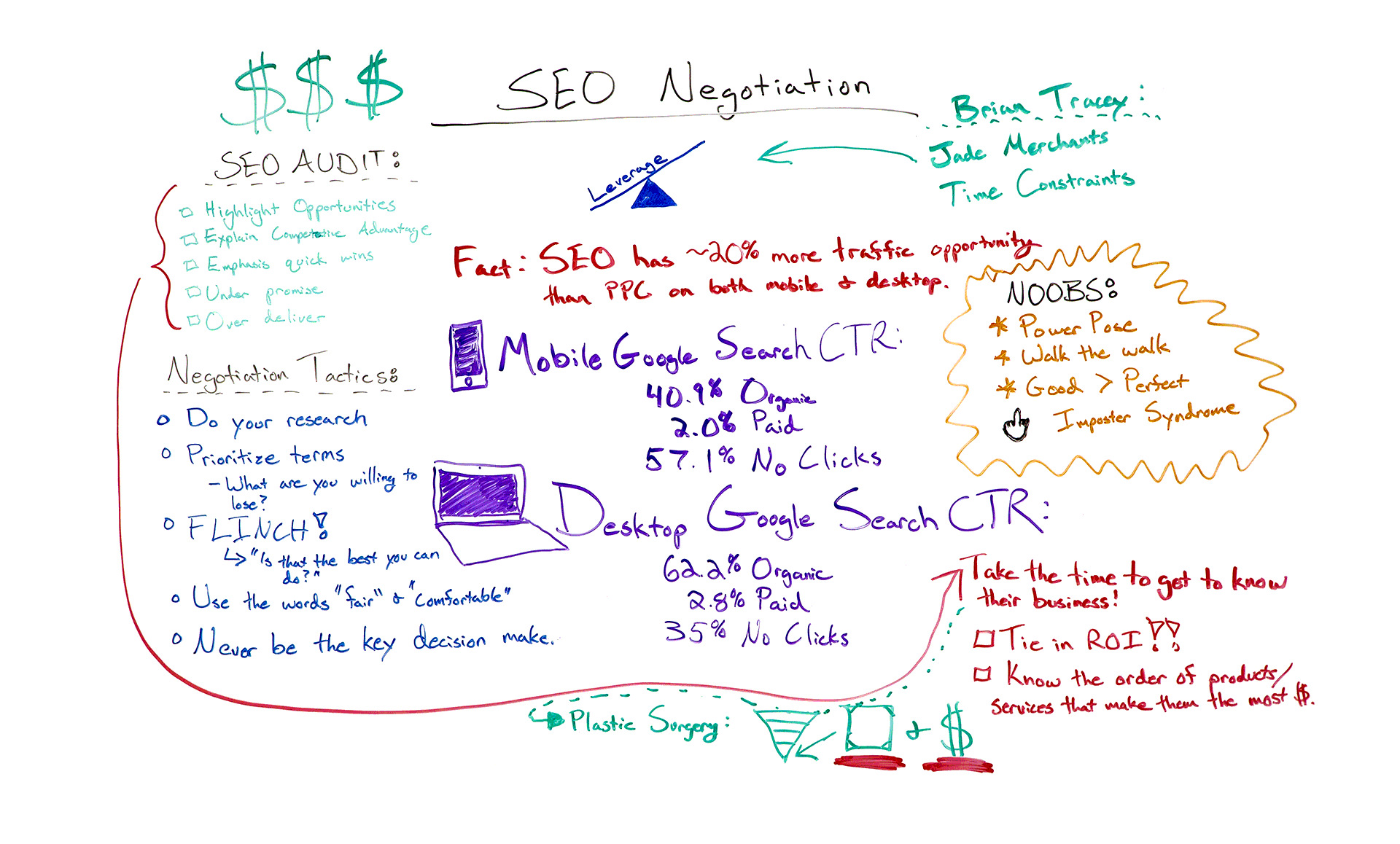
SEO Negotiation: How to Ace the Business Side of SEO - Whiteboard Friday

Posted by BritneyMuller

SEO isn't all meta tags and content. A huge part of the success you'll see is tied up in the inevitable business negotiations. In this week's Whiteboard Friday, our resident expert Britney Muller walks us through a bevy of smart tips and considerations that will strengthen your SEO negotiation skills, whether you're a seasoned pro or a newbie to the practice.

Click on the whiteboard image above to open a high-resolution version in a new tab!

Video Transcription

Hey, Moz fans. Welcome to another edition of Whiteboard Friday. So today we are going over all things SEO negotiation, so starting to get into some of the business side of SEO. As most of you know, negotiation is all about leverage.

It's what you have to offer and what the other side is looking to gain and leveraging that throughout the process. So something that you can go in and confidently talk about as SEOs is the fact that SEO has around 20% more opportunity than both mobile and desktop PPC combined.

This is a really, really big deal. It's something that you can showcase. These are the stats to back it up. We will also link to the research to this down below. Good to kind of have that in your back pocket. Aside from this, you will obviously have your audit. So potential client, you're looking to get this deal.

Get the most out of the SEO audit

☑ Highlight the opportunities, not the screw-ups

You're going to do an audit, and something that I have always suggested is that instead of highlighting the things that the potential client is doing wrong, or screwed up, is to really highlight those opportunities. Start to get them excited about what it is that their site is capable of and that you could help them with. I think that sheds a really positive light and moves you in the right direction.

☑ Explain their competitive advantage

I think this is really interesting in many spaces where you can sort of say, "Okay, your competitors are here, and you're currently here and this is why,"and to show them proof. That makes them feel as though you have a strong understanding of the landscape and can sort of help them get there.

☑ Emphasize quick wins

I almost didn't put this in here because I think quick wins is sort of a sketchy term. Essentially, you really do want to showcase what it is you can do quickly, but you want to...

☑ Under-promise, over-deliver

You don't want to lose trust or credibility with a potential client by overpromising something that you can't deliver. Get off to the right start. Under-promise, over-deliver.

Smart negotiation tactics

☑ Do your research

Know everything you can about this clientPerhaps what deals they've done in the past, what agencies they've worked with. You can get all sorts of knowledge about that before going into negotiation that will really help you.

☑ Prioritize your terms

So all too often, people go into a negotiation thinking me, me, me, me, when really you also need to be thinking about, "Well, what am I willing to lose?What can I give up to reach a point that we can both agree on?" Really important to think about as you go in.

☑ Flinch!

This is a very old, funny negotiation tactic where when the other side counters, you flinch. You do this like flinch, and you go, "Oh, is that the best you can do?" It's super silly. It might be used against you, in which case you can just say, "Nice flinch." But it does tend to help you get better deals.

So take that with a grain of salt. But I look forward to your feedback down below. It's so funny.

☑ Use the words "fair" and "comfortable"

The words "fair" and "comfortable" do really well in negotiations. These words are inarguable. You can't argue with fair. "I want to do what is comfortable for us both. I want us both to reach terms that are fair."

You want to use these terms to put the other side at ease and to also help bridge that gap where you can come out with a win-win situation.

☑ Never be the key decision maker

I see this all too often when people go off on their own, and instantly on their business cards and in their head and email they're the CEO.

They are this. You don't have to be that, and you sort of lose leverage when you are. When I owned my agency for six years, I enjoyed not being CEO. I liked having a board of directors that I could reach out to during a negotiation and not being the sole decision maker. Even if you feel that you are the sole decision maker, I know that there are people that care about you and that are looking out for your business that you could contact as sort of a business mentor, and you could use that in negotiation. You can use that to help you. Something to think about.

Tips for negotiation newbies

So for the newbies, a lot of you are probably like, "I can never go on my own. I can never do these things." I'm from northern Minnesota. I have been super awkward about discussing money my whole life for any sort of business deal. If I could do it, I promise any one of you watching this can do it.

☑ Power pose!

I'm not kidding, promise. Some tips that I learned, when I had my agency, was to power pose before negotiations. So there's a great TED talk on this that we can link to down below. I do this before most of my big speaking gigs, thanks to my gramsy who told me to do this at SMX Advanced like three years ago.

Go ahead and power pose. Feel good. Feel confident. Amp yourself up.

☑ Walk the walk

You've got to when it comes to some of these things and to just feel comfortable in that space.

☑ Good > perfect

Know that good is better than perfect. A lot of us are perfectionists, and we just have to execute good. Trying to be perfect will kill us all.

☑ Screw imposter syndrome

Many of the speakers that I go on different conference circuits with all struggle with this. It's totally normal, but it's good to acknowledge that it's so silly. So to try to take that silly voice out of your head and start to feel good about the things that you are able to offer.

Take inspiration where you can find it

I highly suggest you check out Brian Tracy's old-school negotiation podcasts. He has some old videos. They're so good. But he talks about leverage all the time and has two really great examples that I love so much. One being jade merchants. So these jade merchants that would take out pieces of jade and they would watch people's reactions piece by piece that they brought out.

So they knew what piece interested this person the most, and that would be the higher price. It was brilliant. Then the time constraints is he has an example of people doing business deals in China. When they landed, the Chinese would greet them and say, "Oh, can I see your return flight ticket? I just want to know when you're leaving."

They would not make a deal until that last second. The more you know about some of these leverage tactics, the more you can be aware of them if they were to be used against you or if you were to leverage something like that. Super interesting stuff.

Take the time to get to know their business

☑ Tie in ROI

Lastly, just really take the time to get to know someone's business. It just shows that you care, and you're able to prioritize what it is that you can deliver based on where they make the most money off of the products or services that they offer. That helps you tie in the ROI of the things that you can accomplish.

☑ Know the order of products/services that make them the most money

One real quick example was my previous company. We worked with plastic surgeons, and we really worked hard to understand that funnel of how people decide to get any sort of elective procedure. It came down to two things.

It was before and after photos and price. So we knew that we could optimize for those two things and do very well in their space. So showing that you care, going the extra mile, sort of tying all of these things together, I really hope this helps. I look forward to the feedback down below. I know this was a little bit different Whiteboard Friday, but I thought it would be a fun topic to cover.

So thank you so much for joining me on this edition of Whiteboard Friday. I will see you all soon. Bye.

Video transcription by Speechpad.com


Sign up for The Moz Top 10, a semimonthly mailer updating you on the top ten hottest pieces of SEO news, tips, and rad links uncovered by the Moz team. Think of it as your exclusive digest of stuff you don't have time to hunt down but want to read!


from Moz Blog https://ift.tt/2PArD1s
http://e-bms.de